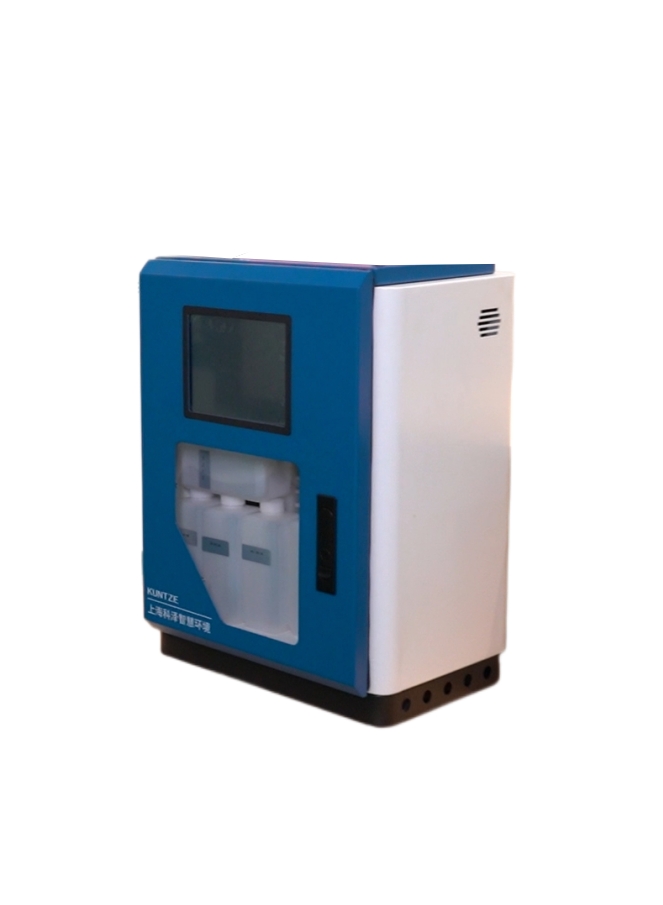
K301S Volatile Phenol Analyzer

Product Introduction

KEZE K301S series online volatile phenol analyzer is an online water quality analyzer independently developed by Shanghai Keze with independent intellectual property rights.

K301S series instruments have good scalability, can realize wireless remote diagnosis and operation, etc. At the same time, the operation program is intelligent, and can automatically adjust the measurement range according to the condition of the water body, adapting to the monitoring of complex water bodies.

Categories

Parameter Direct measurement of  Phenol
Measurement Method 4-AAP spectrophotometric method
Range (0.000~1.000)mg/L
Range Selection Automatic or Manual Range Selection
Multi-Stream Up to two 4-20 mA signals
Repeatability ±3% of reading or ±0.2 mg/L P, whichever is greater
Stability ±2% 
Cycle Time From 40 minutes, depending on range and application
Communication Modbus RTU, Modbus TCP/IP & Profibus (when the Profibus option is selected, the digital output signals are sent through the Profibus converter with its specific communication protocol).
Enclosure Rating IP65
Sample Inlet Temperature 2 – 60 °C
Ambient Temperature 5 – 45 °C
Humidity 5 – 85 % (non-condensing)
Data Storage Previous 9999 analysis data on screen in the microcontroller memory and storage of data archive for the lifetime of the analyzer in the SD/MMC card.
Display Maximum pixels 800*600 backlit LCD with LED backlight
Power Requirements (Voltage) AC(220±22)V(customizable)
Power Requirements(Hz) 50/60 Hz
Service Interval 1 month service intervals
Dimensions(H x W x D) 1371 mm×470mm×372 mm
Weight 60 kg

1 Stability

  • A high-precision sample pump is used for sample injection, enabling accurate measurement.
  • Verification methods include automatic zero calibration with a standard solution, span calibration with a standard solution, and remote standard sample verification, while quality control features automatic spiking recovery determination.

2 Simplicity

  • The analyzer features a touchscreen interface with LCD for easy operation.
  • The analyzer’s system commands are user-friendly, allowing for convenient operation.

3 High Adaptability

  • The analyzer is compatible with high turbidity and high salinity water, supporting both acidic and alkaline permanganate methods.
  • The adaptive technology features automatic intelligent range adjustment, allowing it to smartly adapt to various water types.

4 Low Maintenance

  • The analyzer requires minimal reagent usage while maintaining high device reliability.
  • The analyzer’s maintenance interval can be extended to one month.
  1. Sequential Injection Analysis Platform: Utilizes a sequence injection analysis platform based on a syringe pump and multi-port valve, ensuring high quantitative accuracy.


  1. PID Constant Temperature Distillation System: Stable and reliable with high repeatability.


  1. Low Reagent Consumption: Reduces the amount of reagents used, enhances device reliability, and extends maintenance intervals to one month.


  1. Strong Turbidity Resistance: Excellent capacity to resist turbidity, high measurement accuracy, and good stability.


  1. Intelligent Range Adjustment Technology: The instrument intelligently determines the measurement range of the water sample and automatically adjusts to the appropriate range, allowing for a wide measurement range suitable for complex water monitoring.


  1. One-Key Start: The instrument features a simple operation with a one-key start function.


  1. Comprehensive Automatic Cleaning Function: Equipped with an automatic cleaning feature; it includes automatic status monitoring and fault diagnosis capabilities.


  1. High-Reliability Measurement and Control Unit: Utilizes a highly reliable measurement and control unit that can retain historical data for over three years.


  1. Compliance with National Surface Water Automatic Operation Requirements: Meets national standards for automatic surface water monitoring, with capabilities for automatic zero-point standard solution verification and range standard solution verification, as well as supporting remote standard verification and automatic spiking recovery rate determination for quality control.


  1. The communication protocol complies with the “Technical Requirements for Communication Protocols of National Surface Water Automatic Monitoring Instruments (Revised and Upgraded Version).”

Product Categories